
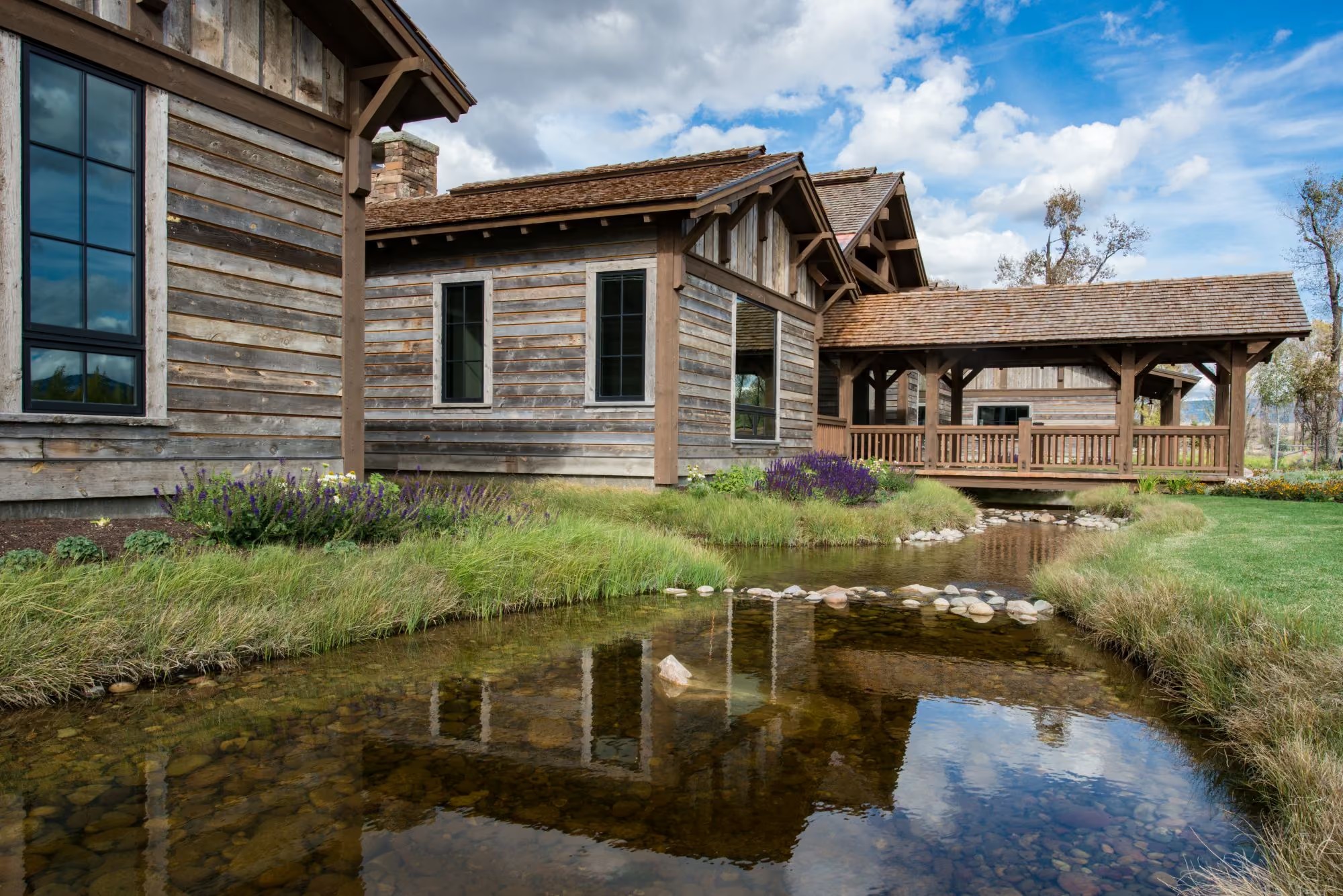
Reclaimed wood brings something to a home that new lumber can’t: a sense of history. Weathered boards, saw marks and the patina of decades give a room character you can’t manufacture.
Reclaimed wood also behaves differently from new material. Choosing it well means understanding where it comes from, what it costs, how much of it you’ll actually use, and where it belongs in a home’s structure. Here’s what homeowners and architects should know before making it part of a custom home.
The phrase “barn wood” covers two very different materials.
True barn wood comes from barns that have been taken down. It has authentic history, but it’s rarely practical for large spaces, unless having wood from an actual barn is part of the story the owners want to tell. Old barns were usually painted to protect the wood, so true barn wood often carries red or white pigment in the grain.
Produced barn wood is material sourced and finished for the weathered look, without the paint. It gives a cleaner silver-gray or brown appearance. It’s also more stable, costs less, and yields more usable wood per board.
For most homes, produced barn wood delivers the look people picture when they say “barn wood,” with fewer surprises.
True barn wood tends to be inconsistent in thickness and width, and much of each board has to be discarded. That low yield means ordering far more material than the finished square footage, which pushes the cost even higher.
At Sagebrush, Wind River Builders used siding salvaged from horse corrals instead of barns. It gave the same weathered appearance with more stability, better yield and a more appealing price.
Reclaimed material is sourced from around the country, so lead times are long, especially on a large project. Plan for it early in design.
On a large home, the material also needs to be consistent: boards and timbers similar enough in character that walls and ceilings read as one. That often means visiting the supplier to see the material in person before committing to it.
Every reclaimed board and timber has more than one face, and each face has its own character. Building with it means deciding which face of each piece points in which direction, and how it will work with the character of the timber it meets.
That’s why an experienced crew matters. The difference between a wall of reclaimed wood that looks intentional and one that looks random comes down to hundreds of those small decisions.
Reclaimed timbers are an excellent choice for rustic and modern rustic accents, and for limited structural roles like trusses, posts and rafters.
They aren’t suited to long structural spans. Old timbers carry checks, nail holes and other flaws, and structural engineers have to account for some amount of flaw when they size them. For long spans, new or engineered timber is usually the better answer.
Wind River Builders has used all three approaches, depending on the home:
The right choice depends on the design, the structure, the budget and the story the home is meant to tell.
Reclaimed and historic-looking materials can make a new home feel as if it has always belonged to its landscape. Getting there takes honest choices about cost and structure, patient sourcing, and a crew that treats every board as part of the whole.
If you’re considering reclaimed materials for a custom home in Jackson Hole, start the conversation with Wind River Builders.
